

18 December 2024
16:57 — two observations at work.
Best time to write a summary? Immediately after the call. More impressive, more motivated, better memory recall.
Listening before judging. I could have done better in a call this morning. Don’t write people off. Don’t bring pre-conceived ideas of right vs. wrong. Listen. Ask yourself: “Why is that person asking the question?” Always goes back to curiosity over judgment.
17 December 2024
14:55 — on our biggest fear.
“Death is not the biggest fear we have; our biggest fear is taking the risk to be alive — the risk to be alive and express what we really are.” — Don Miguel Ruiz, The Four Agreements
This is strong. Like the story I wrote about the men with the vacant stares. They didn’t follow their dreams. They are not here. They are living in a dream, who they could’ve been, while going through the motions (being a lawyer of doctor and family man) in their actual lives. Steven Pressfield says something similar in the War of Art.
14:50 — worrying/overthinking = something that seizes your future.
“They had a term, too, for that thing I did where something would bother me and I would immediately project forward to an unpleasant future (e.g., Balding → Unemployment → Flophouse). The Buddhists called this prapañca (pronounced pra-PUN-cha), which roughly translates to “proliferation,” or “the imperialistic tendency of mind.” That captured it beautifully, I thought: something happens, I worry, and that concern instantaneously colonizes my future.” — Dan Harris, 10% Happier
14:47 — on labels.
“So in the fixed mindset, both positive and negative labels can mess with your mind. When you’re given a positive label, you’re afraid of losing it, and when you’re hit with a negative label, you’re afraid of deserving it.” — Carol S. Dweck, Mindset
Need more people to read this.
14:45 — on becoming the pictures we make.
Iris Murdoch’s words: “Man is a creature who makes pictures of himself and then comes to resemble the picture.” — David Brooks, The Second Mountain
Interesting observation. We believe (become) the stories we tell ourselves. Ties in with affirmations.
11 December 2024
16:46 — thoughts and feelings are just like the wind, they come and go, they don’t define you.
“The final step—“non-identification”—meant seeing that just because I was feeling angry or jealous or fearful, that did not render me a permanently angry or jealous person. These were just passing states of mind.” — Dan Harris, 10% Happier
16:35 — some great rules from Scott Adams in How to Fail at Almost Everything and Still Win Big:
Goals are for losers.
Your mind isn’t magic. It’s a moist computer you can program.
The most important metric to track is your personal energy.
Every skill you acquire doubles your odds of success.
Happiness is health plus freedom.
Luck can be managed, sort of.
Conquer shyness by being a huge phony (in a good way).
Fitness is the lever that moves the world.
Simplicity transforms ordinary into amazing.
I’ve made sketches of numbers 4 and 6.

16:25 — interesting to track how people engage in conversation.
I see this in others (and myself) sometimes. They don’t understand the current topic of conversation (or they’re not interested in it) and they hijack the conversation by asking a random, unrelated question to one of the group members. Like - hey, you guys forgot about me, fuck this current topic, let’s talk about me and what I want.
Sad to see. Happens often with people who aren’t aware of what they’re doing. They just act on impulse.
16:22 — the blessing/curse of busy-ness and constant stimulation. This hits hard. The alternative (facing your demons) is tough but ultimately worth it.
“Your mind is afloat and at the play of prompts. Do not flatter yourself in thinking that you’re brave enough or capable enough to see into the deepest and most important parts of yourself. One of the reasons you are rushing about is because you are running away from yourself.” — David Brooks, The Second Mountain
15:51 — creating a positive loop.
“Not letting my mind get locked in negativity made space for something else to emerge. I experienced a phenomenon I had heard Joseph once describe: a virtuous cycle, in which lower levels of anger and paranoia helped you make better decisions which, in turn, meant more happiness, and so on.” — Dan Harris, 10% Happier
15:40 — I’ve been taking a lot of notes. I’ve been working in the background.
Something is happening.
I just need to make sure it doesn’t slip out of my grip.
I am going to write about the workplace - about emotional intelligence, managing yourself, presenting yourself, being a good colleague, mindfulness at work (zoom out, creative a positive loop), people skills (don’t steam roll), storytelling (make jokes to lighten the mood), fun anecdotes and tales, book reviews (Good Work, Slow Productivity etc), personality tests (how my Briggs-Myers changed).
This will be fun. And it can build into somehting bigger. Like a book. Every week I will capture my thoughts in a newsletter. I will capture quotes. I will create a thesis - you need to do good work, but you need to be realistic, don’t be naive.
I can repurpose the newsletter for LinkedIn.
It can also become a course. Interesting angle.
I might have to go back to a personal site with personal branding. Could be a good move. Substack is good for distribution, but personal site is important for my brand and SEO. Capture some of the pieces as standalone essays. Check out Janis Ozolins. Big fan of his work — he writes a short, punchy newsletter, he creates great visuals and he has a personal site with distribution via Substack.
Want to do interviews (podcast format). Maybe ask the same few questions every time. Make it fun, make it personal. Get a good mic. Get a good outfit and background.
Want to start with Arthur Goldberg. Book him soon.
More action. I’ve been in hibernation/thinking mode for a long time now. It was good for me. I took a step back but I’m ready to come back now.
It’s like what I spoke to Michael Sklar about — at the start you don’t know what to write about, so you write about everything. People are confused, you are directionless, but it’s fine, you’re practicing, you’re getting the reps in. Later, when you have your big idea, you can harness those skills you’ve learned (crafting an essay, sketching an idea, performing an interview) and unleash them on your topic.
This is the thing - I am motivated by these things. You will always outwork someone else if they are not passionate about it.
Carla Venter from Money with Carla approached me earlier this year to co-write a newsletter on personal finance. We had a few calls but it didn’t work out in the end. It wasn’t a match. She was super excited about the space, she lived and breathed personal finance. I was lukewarm about it. Sure, I knew all there was to know about investing and saving wisely (I had worked at an asset management firm for 6 years), but I wasn’t passionate about it. The ideas felt obvious to me (invest when you’re young, invest in ETFs, set up a budget etc.), but Carla was excited to share this with financially illiterate people. She had a mission. I was just going to hold her back.
Same with Tobi Emonts-Holley. His brand of waking up early, being disciplined, working out, being a good dad, getting a lot of things done in a day has a large following and he’s doing good work. But all these things feel obvious to me (even if I don’t achieve his insane level of discipline) so I’m not as motivated to read or write about it.
And the same will probably be true for my “niche” (doing good work, doing meaningful work). Some people might find this boring or obvious. Some people might be doing this naturally. But I’m excited about it. I had to come from a place where I wasn’t very emotionally intelligent (didn’t have expanded awareness) to a place where I constantly work on it.
15:39 — on the value of staying open-minded.
““You have to carry a big basket to bring something home.” She repeats that phrase today, to mean that a mind kept wide open will take something from every new experience.” — David Epstein, Range
14:21 — on pseudo-productivity.
“A leader must know when his team is making a lot of noise signifying nothing. UCLA’s coach John Wooden summed it up like this: “Don’t mistake activity for achievement.” — The Score Takes Care of Itself, Bill Walsh
Reminds me of clockwatchers at work. “Look busy, Jesus is coming” great line from Johnny English. Heuristic called pseudo-productivity, which says activity (being online, replying to emails and Slack quickly) is our proxy for doing useful stuff (actually being productive).
10 December 2024
10:25 — on keeping expanded awareness at work.
When I don’t meditate, my awareness collapses. I get stressed, I get tunnel vision, I don’t perform as well. It happened today on a call. I was too eager, too intense. Other people could sense it. They were more zen. I wasn’t. It’s like the Alexander Technique but for business — posture of the mind. When you’re tight, everyone can tell.
10:18 — on aligning internally.
Always align internally before going out to a client. I know the temptation — you want to impress, you want to show initiative, so you go straight to the client with your ideas. But you miss an opportunity. For more inputs, better feedback, and making others feel part of the process. The extra step feels slow, but it makes the output stronger and the team tighter.
05 December 2024
10:27 — like this description of a meaningful vocation. Length x breadth x height = volume.
“Martin Luther King, Jr., once advised that your work should have length—something you get better at over a lifetime. It should have breadth—it should touch many other people. And it should have height—it should put you in service to some ideal and satisfy the soul’s yearning for righteousness.” — David Brooks, The Second Mountain
04 December 2024
08:35 — you want to be antifragile. In most things in life, the most important thing is to never be wiped out. Stay in the game.
“Climb if you will, but remember that courage and strength are nought without prudence, and that a momentary negligence may destroy the happiness of a lifetime. Do nothing in haste; look well to each step; and from the beginning think what may be the end.” — Jon Krakauer, Into the Wild
08:26 — I didn’t love reading Overstory, it’s kind of depressing, but it does achieves its goal. It makes you more aware of your place in the broader world. Everything is interdependent. The damage we do to the environment will ultimately damage us.
“To be human is to confuse a satisfying story with a meaningful one, and to mistake life for something huge with two legs. No: life is mobilized on a vastly larger scale, and the world is failing precisely because no novel can make the contest for the world seem as compelling as the struggles between a few lost people.” — Richard Powers, The Overstory
08:23 — As I get older, I’m becoming more ruthless about who I spend my time with. I will no longer do things to please others. I will only spend time with people who are aligned with my values and desire to grow.
“Given our human impulse to pick up the habits and energy of others, you can use that knowledge to literally program your brain the way you want. Simply find the people who most represent what you would like to become and spend as much time with them as you can without trespassing, kidnapping, or stalking. Their good habits and good energy will rub off on you.” — Scott Adams, How to Fail at Almost Everything and Still Win Big
08:21 — it’s good to be busy, but don’t just be busy for the sake of being busy. Next step is to do something meaningful.
“Health lies in action, and so it graces youth. To be busy is the secret of grace, and half the secret of content. Let us ask the gods not for possessions, but for things to do; happiness is in making things rather than in consuming them.” — Will Durant, Fallen Leaves
Build things, create more than you consume, leave an impact.
03 December 2024
17:23 — this is beautiful. So much time is lost in comparison and overthinking. Just be the best version of you. Tune out the noise.
“How much time he gains who does not look to see what his neighbour says or does or thinks, but only at what he does himself, to make it just and holy.” — Marcus Aurelius, Meditations
17:20 — this is what great writers and teachers achieve. They show us a better way to experience spiritual life.
“As Joseph Campbell put it in an interview with Bill Moyers, there are two types of deed. There is the physical deed: the hero who performs an act of bravery in war and saves a village. But there is also the spiritual hero, who has found a new and better way of experiencing spiritual life, and then comes back and communicates it to everyone else.” — David Brooks, The Second Mountain
17:18 — enjoyed this lesson from The Great Mental Models by Shane Parrish:
Hanlon’s razor: don’t attribute to malice that which can be explained by stupidity.
Makes life easier when you keep this in mind. Useful at work. Useful everywhere, actually.
17:15 — heard an interesting take on the main lesson from Jim Collins’ Good to Great. Running a company successfully comes down to two things:
Hiring the best people. It’s difficult to run a company with low-talent people.
Deploying these people on your biggest opportunities. 80/20 rule. Let team members play to their strengths. Putting someone in the wrong role is not the best use of their talents. Make sure the superstars are talking the biggest challenges, let the 20% unlock 80% of the value.
Reminded me of Paul Graham’s analogy about the startup vs. the big corporate.
You want 10 good rowers in a canoe instead of 1000 people in a big boat. They are stronger, more aligned and can move faster than the big boat full of passengers (extra weight) and competing interests.
Also ties in well with the concept of Match Quality from Range.
““Match quality” is a term economists use to describe the degree of fit between the work someone does and who they are—their abilities and proclivities.” — David Epstein, Range
01 December 2024
16:35 — On why I’m doing an MBA:
“One of the best pieces of advice I’ve ever heard goes something like this: If you want success, figure out the price, then pay it. It sounds trivial and obvious, but if you unpack the idea it has extraordinary power.” — Scott Adams, How to Fail at Almost Everything and Still Win Big
This is how I think about the MBA. I figured out the price — this will cost me time, and put pressure on my marriage — but I’m paying it because I know it will open doors for me.
16:32 — This is what I’m trying to do with my writing and with the pivot to business topics.
“Our goal for your life is rather simple: coherency. A coherent life is one lived in such a way that you can clearly connect the dots between three things: 1. Who you are 2. What you believe 3. What you are doing.” —Bill Burnett and Dave Evans, Designing Your Life
16:29 — Experience this to some degree as well. Became too relaxed, too laissez-faire. ‘Anything goes, if that makes you happy, go for it, even if it’s at my detriment’.
“People will take advantage of you if they’re reading you as too Zen,” he said. “There’s a certain kind of aggression in organizational behavior that doesn’t value that—that will see it as weak. If you present yourself too much like that, people won’t take you seriously. So I think it important to hide the Zen, and let them think that you’re really someone they have to contend with.” — Dan Harris, 10% Happier
28 November 2024
08:45 — on mindset.
The habit of writing has made me much more observational.
In the past, I would easily zone out if a conversation or meeting didn’t interest me. Now I get a second bite of the apple. I observe the dynamics in the room, I notice my energy levels, I interrogate myself and try to learn things.
It’s a relief. Anything can be interesting.
25 November 2024
22:37 — Cool quote I heard from a client the other day.
Yiddish proverb: Der mentsh trakht un Got lakht.
Man plans and God laughs. Brilliant.
22:31 — Entry to the game vs. your magic.
Working with Unisure, they focus a lot on what you need as a bare minimum vs. what they do that is unique to them.
Certain things are entry to the game e.g. you need a website to sell online. Others are unique to you e.g. you have extremely good customer service.
Draw triangle. Inside = magic. Outside = entry to game.
22:33 — on making slides.
Always good to use progression.
A-B-C-D.
Can’t just throw it all at them at once, help people parse a lot of info.
22:31 — Beethoven wisdom:
“If I don’t write it down right away, I instantly forget it. If I write it down, I never forget it and don’t have to look at it ever again.” — Ludwig van Beethoven
22:30 — on finding my niche.
I really like the game. The body language, the things that are not said, the emotional intelligence — or lack thereof — in a room. The business is interesting, it’s entry to the game. But the magic is in between the lines. Have I found my niche? Poeple, observing, seeing behind the curtain. Such a good feeling.
Somehting that pairs well with this:
Strive not to be the smartest in the room, but to lift the smartness of the room.
21 November 2024
16:44 — fighting culture = good thing.
I love this quote from David Brooks:
“If I had to capture the core of my Jewish experience, it would be this: Eighteen people sitting around a Shabbat dinner table, all of them talking at once, all of them following all eighteen conversations that are simultaneously crossing the table, all of them correcting the eighteen wrong things that other people have just said.” — David Brooks, The Second Mountain
There’s something beautiful about a culture that encourages you to challenge, to disagree, to speak up at the table. Growing up in the Afrikaans culture, I experienced the opposite. You didn’t challenge your elders. You listened, you respected, you fell in line. I was lucky — my parents were less conservative than the wider culture — but the instinct to not rock the boat still runs deep in me.
WIP.
Definitely want this for my kids one day, more of a fighting culture, disagreeing respectfully.
16:36 — Cool motto:
“Corny or not, I found that old journalistic injunction to “comfort the afflicted and afflict the comfortable” inspiring.” — Dan Harris, 10% Happier
16:31 — on how I want to shape my newsletter going forward.
I’ve been thinking about what my newsletter could look like going forward. Something short, punchy, weekly. A mix of:
Thought of the week — a single idea, explored briefly
Book of the week — whatever I’m reading
Quotes worth saving
A sketch or visual — something hand-drawn or a simple diagram
A photo — something personal, a window into the week
Less advice, more sharing. Less “fix your life” and more “here’s what I noticed.” I want it to feel like opening a letter from a friend, not attending a lecture.
Big fan of how Janis Ozolins does his… short, visual, personal, with a standalone site for the longer essays.
Potential names:
Creators’ Corner doesn’t feel like a fit anymore. It served me for a long time, but also recognise when it’s time to move on. I see the value in creating, I also see the value in earning a living (sometimes that means corporate). One doesn’t have to exclude the other.
The People Business
The Human Business
Human Co.
Maybe I should just call my newsletter my name. Plain and simple.
[I ended up doing just this - Johnnicholas.org]
12 November 2024
11:01 — applied to do an MBA(!).
Some notes from the careers team intro at IMD:
“The airport test”: would I spend time with you at the airport or like it if you were in the seat next to them? Be personable.
“The laywer test”: Can you pitch and defend your opinions? How good are you at speaking on the spot, pushing back where necessary?
08 November 2024
14:16 — my sentiment for my newsletter going forward.
Wrote this note late one night. Been reading too many ‘fix your life’ type posts lately. What if everything was good and people just wanted some entertainment?
Stop telling people what to do. Just create nice things. Share nice things. There are enough threadbois on X. Make visuals. Share photos. Share stories. Create videos. Everyone has enough on their plate. They’re looking for beauty. Looking for novelty, a snap out of the mundane.
07 November 2024
15:40 — on overreacting when people question your credibility.
Observed this earlier this week. The CEO of a company I’m consulting to felt his company was being undervalued by a business partner.
What followed were a series of emails and presentations to re-establish the company’s standing and reputation.
Interesting observing this from the sidelines. The partner company is bigger — they probably have a lot going on. Maybe they weren’t being as respectful as they could’ve been, but they just wanted to get the deal done. They weren’t looking to protect feelings.
Lesson: don’t be too sensitive. I’m susceptible to this too.
03 November 2024
11:09 — don’t be patronising:
“When we presume to lie for the benefit of others, we have decided that we are the best judges of how much they should understand about their own lives—about how they appear, their reputations, or their prospects in the world.” — Sam Harris and Annaka Harris, Lying
11:06 — don’t just write because you want to be a writer, write because you need to share something:
“What matters more now than any other single thing is that what you’re saying is different–that it’s interesting, that it provokes some response from people. You’ll only accomplish this if you’ve got something you have to say. Better yet, you need to have something that you can’t NOT say. If what you’re writing is a compulsion rather than a vehicle for your display how smart and well practiced you are.” — Ryan Holiday, So You Want to Be a Writer? That’s Mistake #1
Guilty of this sometimes. Am I wrting to show off or am I writing because I can’t NOT write? Hmm.
31 October 2024
17:10 — on making time for creative work.
This is my biggest challenge at the moment.
Two things are true:
I feel good when I write and publish. I know it will reward me in the short term (clarity of thought) and in the long term (having a body of work).
There are immediate financial considerations. My consulting business gives me stability, and since I sell my time, I’m always “on call”.
I’m trying to make time for writing, but I’m currently prioritising consulting. The outcomes are clearer — I put in X hours, I earn Y Euros. With writing, there’s no guaranteed result, especially not a financial one.
I’m a little sad it’s come to this, but I can’t justify a luxury habit like writing when other needs on Maslow’s pyramid need taking care of.
My solution: block out sacred writing time — at least two hours per week — where I ‘pay myself’ to write. I become my own client. If anyone asks, I’m working on another project. Technically, it’s true.
16:57 — the two wolves inside me - the creative and the accountant.
I feel this inner tension between doing creative work and doing work that gives me safety and comfort.
I gave the creative free reign last year, but I lost about 75% of my income. I felt fulfilled, I was making good connections, but the bank account was bleeding.
Can they live in harmony? I think so. But the creative needs to accept that the accountant keeps the lights on. And the accountant needs to accept that without the creative, there’s nothing worth keeping the lights on for. No purpose, no hunger.
[funny reading this a year later having read Steppenwolf - does every man contain the Steppenwolf?]
16:44 — on listening to life.
“Listening to life means asking, What have I done well? What have I done poorly? What do I do when I’m not being paid or rewarded? Were there times when I put on faces that other people wanted me to wear, or that I thought other people wanted me to wear?” — David Brooks, The Second Mountain
30 October 2024
10:25 — on the future of writing.
Always excited to see PG release a new essay. It’s like opening a present on Christmas morning.
This one is about the future of writing, and by extension, thinking.
Paul predicts that due to (1) the pressure to produce good writing and (2) the sheer difficulty to write well, only a select few people will continue writing, while others will resort to using LLMs to do the work for them.
Similar to how work kept people in shape in the industrial era, and now only the people who want to stay fit, exercise, the same will apply to writing. Writing was part of the job, it kept people sharp. But in future LLMs will do the heavy lifting, so only the people who want to write (and use writing to think) will continue practising this muscle.
29 October 2024
21:31 — on finding a role/job/vocation that expresses the best version (or the most sides) of you.
People contain multitudes. They have multiple talents and interests. Like a gemstone with multiple brilliant, shiny, sparkly sides and edges.
Corporate doesn’t always get this. A role in a company prefers you to be a specialist, to show one side of your gemstone. It sells you short.
You might be interested in podcasting,
Your mission in life is to find a vocation that can bring those qualities to light.
21:29 — went to see Nick Cave last week. What an artist. The raw emotion, the storytelling, the engagement with the audience, all made for a memorable show.
Love these lyrics from Into My Arms:
“I don’t believe in an interventionist God
But I know, darling, that you do.
But if I did I would kneel down and ask Him
Not to intervene when it came to you”

12:52 — Morgan Housel on freedom.
“The ability to do what you want, when you want, with who you want, for as long as you want, is priceless. It is the highest dividend money pays.” — Morgan Housel, The Psychology of Money
Almost there.
28 October 2024
11:13 — saved this one before. This, this is the quality to seek in people.
“What he loved in horses was what he loved in men, the blood and the heat of the blood that ran them. All his reverence and all his fondness and all the leanings of his life were for the ardenthearted and they would always be so and never be otherwise.” — Cormac McCarthy, All the Pretty Horses
11:11 — on being in flow. Can’t think while doing. Surrender to doing.
“A pitcher who is thinking about how he is pitching cannot pitch well. His focus is on self, not the task. “In any hard discipline, whether it be gardening, structural engineering, or Russian,” the philosopher and motorcycle mechanic Matthew Crawford writes, “one submits to things that have their own intractable ways.”” — David Brooks, The Second Mountain
27 October 2024
23:01 — truth vs. fiction.
In their recent talk, Sam Harris and Yuval Noah Harari discuss the different qualities of truth and fiction.
Telling the truth carries a high cost — it is often painful, and it is usually complicated.
With fiction, you can make what you want it to be. Which poses a big danger in the information age e.g. Russian bots on Twitter.
It’s easy to spread disinformation, it’s hard to tell the truth.
I would also say there can be an overlap — writing fiction is sometimes an easier or more effective way of sharing the truth (less on the nose). E.g. Don’t Look Up is a comedy/satire about climate change. Or writing a semi-biographical novel instead of naming complicated relationships with family.
22:44 — the roots of vulnerability.
“Vulno” comes from “wound” in Latin.
22:42 — Sales 101.
Don’t sell them on features.
Try to determine what transformation the customer is looking for (the deeper benefits of the product), then explain how it works (features of product).
22:17 — on using fear to guide you.
“Casey Gerald’s question: What would you do if you weren’t afraid? Fear is a pretty good GPS system; it tells you where you true desires are, even if they are on the far side of social disapproval.” — David Brooks, The Second Mountain
16:04 — on the value of books.
Writing a blog is pretty cool, but the ultimate goal is to write a book one day.
The blog is a good space to practice and test ideas. The book focuses your attention on a larger theme and brings your entire philosophy together.
11:37 — today is my 1-year “logging” anniversary.
This was my first post:
12:25 — on speaking your truth and not hiding in the shadows.
“Speak your latent conviction… Else tomorrow a stranger will say with masterly good sense precisely what we have thought and felt all the time, and we shall be forced to take with shame your opinion from another.” — Ralph Waldo Emerson
When you think of something but don’t have the guts to write about it. Only to see someone else share the same sentiment a short while later. Why hold back? What are you scared of? (questions for the guy in the mirror)
I wrote about the advantages of the habit here:
I like this practice for several reasons:
Info capture (premium version). I am used to taking random notes in Google Docs and on my phone, but you put in more effort when posting a note in public. These ‘polished’ notes are easier to upcycle into longer writing later on.
Daily writing habit. I did Morning Pages for a couple of months at the start of 2022. The practice was useful but I eventually lost steam. The main thing I regret is not capturing the noteworthy segments from each day’s writing. With logging, you curate the best extracts for future use. Less waste.
Notice-taking. Every conversation, every interaction, every random daydream has value and can potentially be used in a future essay. With logging, I am reinforcing the habit of taking notice of these everyday occurrences.
Low stakes / no rules. Logs can be any length, they don’t need titles, they can be little fragments of thoughts or longer streams of consciousness. I’m still publishing, but there’s less pressure to create a clean, reviewed newsletter. This allows me to get something out in 5-10 minutes (newsletters take 2-8 hours), which is great for momentum and habit maintenance.
Writing with less fear. “Ooh, I don’t know how this will land with people, maybe I shouldn’t write this.” Enough of that. I want to speak my latent convictions. I want to share my thoughts instead of silencing myself. Writing logs has revived my confidence.
A year in, all of these benefits still hold true. I would say number 3 (notice-taking) is probably the biggest one. When I write, I take better notice of my life. I get two bites of the apple. Without writing, life feels like feels like it just slips away.
Another benefit (#6) is to see ideas cross-pollinate. It’s like my own second brain or personal knowledge management (PKM) system. Sometimes I see two or three quotes from different authors on the same topics e.g. doing the work for the work itself (Hesse, Walsh, Brooks) or the value of self-development (Wilde and Pirsig).
So far I’ve captured *a lot* of logs. Would be cool to build the log app and add some features like a log counter.
Days I’ve logged on:
Q4 2023: 49
Q1 2024: 36
Q2 2024: 42
Q3 2024: 43
Q4 2024 (so far): 20 roughly
Total: ~170 / 365
Ran a basic “find” function on “2023”/”2024” looking for the subtitles so there might be overcounting.
A count function on “:” could work to count the number of logs.
26 October 2024
13:16 — on why certain people put me off.
“Anything you say is fine as long as it is not complaining, rude, or unpleasant.” — Leil Lowndes, How to Talk to Anyone
I’m not always good at putting my finger on why people put me off, but I always have a gut feeling that’s something off.
Usually it comes down to one of the things Lowndes mentions:
Complaining
Being rude
Being unpleasant - which could include bragging or making the conversation all about yourself.
12:20 — cool quote from One Chance featuring James Corden.
“The mark of a father’s success, is by how far his children surpass him in life.”
12:10 — on the real reason I get sick sometimes.
Often when I fall ill, it’s quick and fleeting. There’s no deeper reason, apart from being overworked or partying over the weekend or travelling and being exposed to germs.
Other times, it’s psychological. There’s some underlying reason. Especially when it takes longer to recover and when medicine and rest don’t work as quickly as they usually do.
I’m going through one of these spells now. I committed to doing an MBA next year, which is exciting, but also daunting. Putting a lot of pressure on myself financially (tuition plus lost income from studying full time) and there will also be stress on my marriage (doing long distance for the first time).
Because of this, I’m feeling a low-key constant stress.
I know there are good things on the horizon (things I can’t conceive of) and I’m comfortable with the trade-off: short-term discomfort for long-term gain. But even if I rationalize this in my brain, my body is still expressing that stress. The short-term pain is still very real and can’t always be compartmentalized away.
The last time I got this sick from underlying stress was when I signed up for Write of Passage in 2021. It was a lot of money at the time, but the real investment was my time (lots of late nights) and
Dan Harris (10% Happier) mentions something similar about experiencing depression after reporting from war zones in Iraq, Israel and Pakistan. He was constantly sniffly, lethargic and unenergetic. He tested for Lyme disease, asthma, fatigue etc with no luck. The doctors couldn’t pinpoint the issue. In the end, he spoke to a psychiatrist who immediately figured out he was suffering from depression.
Rik van den Berge (my sparring partner) describes the same thing in his essays. He had struggled with health issues for a long time. He went from doctor to doctor with no luck. Eventually, he took ownership of his life. He stopped playing the victim. He proactively ran some experiments (cold showers, exercise, eating well, coaching). Miraculously (or obviously) his health issues lifted.
I also shared a story about a US doctor who quit because the healthcare system focused on cure rather than prevention. Many of his patients suffered heart issues because of stress, poor eating habits, smoking and drinking. All of which could easily have been avoided by living a healthier life. The hospitals aren’t incentivised to focus on prevention. Their business model focuses on making money from sick people.
Important to notice this and acknowledge your true feelings. Often you don’t need meds, you just need to get in touch with what’s going on under the surface.
That’s the point of meditation, I suppose. Being mindful of what’s going on in your body and your mind.
12:05 — essays I still want to write this year.
Switching to “John’s Newsletter” or “Master of Some”. Not a creator anymore. Really like business. Like business lessons. Like life lessons. Charlie Munger’s book is brilliant. I don’t hate money anymore. I don’t hate corporate anymore.
Doing the work for the work itself.
Being a participant and an observer at the same time. This is meditation.
When the quotes don’t work anymore. On snapping out of my creator-dream. Running out of runway. Doing work-work again.
Enjoying work again. Enjoying the 9-5 again.
Self-employment. You can do whatever you want. Blessing and a curse.
Rattling the snowglobe. My decision to pursue an MBA. Disruption, getting out of my comfort zone. Rik: “Isn’t it interesting that taking a bet on ourselves feels daunting, when from the outside in it’s often so clear that we should.” How tough it was to make my MBA decision. And how good it was to make this type of call. It’s a vampire problem. I’ll share stuff next year. Maybe I’ll share what I learn, but I also don’t expect it to take over my life. I don’t see myself going all in “John does an MBA” finfluencer vibes. I’ll still have other interests. I see how an MBA could seem like a step toward corporate again. I don’t think I’ll go down that route. I prefer working with smaller teams. Having an impact. Strategy, prod dev, pricing. Helps me shed that ‘actuary’ label.
Shedding the actuary identity. The label never quite fit, being an actuary, felt like wearing a L when I’m actually an XL. Restricted me. I contain multitudes.
11:45 — reading update 2024.
I summarized my first 12 reads of the year on 4 April 2024.
I then summarized the next nine books (13-21) on 17 May 2024.
The next six (22-27) on 26 July 2024.
Here are the next five (28-32).
Finished:
Kim by Rudyard Kipling (1901). 4/5. Brilliant. A charming classic with a great narrative and ample depth. A tale about India and the impact of British Colonization told from the point of view of an Irish orphan who grew up on the streets and becomes a beggar (or chela) for a wiseman. A meeting of East and West in one person. Enjoyed the elements of Eastern mysticism (old world wisdom, Bhuddist teachings), mixed in with Western views (modern, ambitious, but also naive and condescending).
The Second Mountain: The Quest for a Moral Life by David Brooks (2019). 3/5. A fine read, but slightly disjointed. You can see Brooks had an overarching theory (finding maturity later in life, defeating the ego etc.) but he tried to pull off too much in one book. The part on religion (and his spiritual journey) felt particularly out of place and not tied in with the bigger theme. I would still recommend reading it, if only for the quotes.
Non Violent Communication: A Language of Life by Marshall B. Rosenberg (1999). 4.5/5. Super impressed by this. One of those “a-ha” books you read from time to time. Can I say life-changing? It definitely made me more hopeful about life. Can see this improving all my relationships. With my family, with my partner, with my colleagues, with myself. Up there with “Lying” (Sam Harris) and Spiritual Enlightenment (Jed McKenna) in my top non-fiction books of the year. A book I’d like to revisit from time to time. The main message is not to add judgment to your conversations and to express your true feelings. Always speak from what you would like coupled with how the situation makes you feel instead of telling others what to do and adding judgment. Can write this a bit better for a book review.
The Three Sisters by Anton Checkhov (1901). 3/5. I read Chekhov’s book “The Duel” earlier this year and enjoyed this lesser-known, but still great, Russian author’s views on life — finding meaning even when it seems there is no meaning. The Three Sisters is a little bit more absurd. It was written for theatre, so it doesn’t read that smoothly, but the same themes come out. Three sisters are stuck in the countryside and long to move back to the big city lights in Moscow. Their hopes are dashed and they are left disillusioned, resigned to the fact that they’ll grow old in the countryside and not fulfill their dreams.
Good Work by Paul Millerd (2024). 4/5. I like Paul’s writing. The Pathless Path, his first book had a big impact on me. At the time, I was going through a work/life-transition. I was at a company that made my life miserable. Bureaucracy, uninspired colleagues, lots of barriers to innovation. When I read The Pathless Path I felt seen. I was like - finally someone gets me - corporate sucks and I should quit and become a creator (go self-employed). I’m happy I did get out, but I’ve also matured since then and found work I enjoy. I took one bad experience and painted all corporate jobs as soul-sucking, uninspiring places where dreams go to die. This year my hope has been rekindled. I actually enjoy work again. I also think I’m good at it. Or at least better at it than say tweeting (so happy I’m off X). So when I read Good Work (which is basically a continuation of The Pathless Path) I was less taken with it. It’s still worth reading and it’s good figuring out your bad work, good-enough work and good work, but I no longer agree with the whole creator-good-corporate-bad narrative. There are many different ways to express your skills and talents. Not everyone will become a published author one day.
Currently reading:
Poor Charlie’s Almanack: The Wit and Wisdom of Charles T. Munger by Charlie Munger. 5/5. What a read. This should be required reading at universities. A masterclass in economics and psychology.
10% Happier by Dan Harris. 4/5. This a cool book. Dan and I share a similar world view on religion and spirituality. Born sceptics, seeking deeper meaning in life. Never very religious, but open to ideas. He also didn’t vibe well with Deepak Chopra or Eckhart Tolle. Eventually he stumbled upon Mark Epstein (Buddhism), Sam Harris and Joseph Goldstein (meditation) and things started making more sense. The book’s title is unfortunate - sounds like a typical, gimmicky self-help book. It’s more like “An Introduction to Meditation for Sceptics”.
The 4-Minute Millionaire by Nik Göke (2021). 4/5. Solid book by my friend Nik. It’s a crash course in all the basic money rules. He explains a few common traps people fall in and I myself have fallen in e.g. not liking people with money (calling them trust fund kids etc). If you do that, then you’ll never get rich.
One Hundred Years of Solitude by Gabriel García Márquez (1967). 50% in. This has been a drag. Struggling through it. No idea why this book is so highly acclaimed. It’s a confusing mess of family names and events and war and firing squads. There doesn’t seem to be a point or bigger theme. Things just happen. Absurdist? Not my vibe. Might shelve.
Stopped reading / shelved:
The Power of Now: A Guide to Spiritual Enlightenment by Eckhart Tolle (1997). This was disappointing. Expected more. A New Earth (his second book) was better in my opinion. Couldn’t really get a hold of the teaching and jargon this time. More confusing than helpful.
Sex at Dawn: The Prehistoric Origins of Modern Sexuality by Christopher Ryan, Cacilda Jetha (2010). So-so so far. While I’d be very interested in a relevant, science-based book that backs up why polyamorous/polygamous relationships work (happy to be challenged), this was not it. They made their point early on, now it’s a drag. Filled with rhetorical, strawman arguments. Everything that goes against their point is written down as uptightness and religious conformity, while their view is the only conceivable solution. 2/5.
11:35 — Charlie Munger on self-pity.
“Self-pity is always counterproductive. It is the wrong way to think.”
“The idea of ‘woe is me’ is a way to fail. To wallow in self-pity just keeps you down.”
“Whenever you think that some situation or some person is ruining your life, it is actually you who are ruining your life. It’s a fundamental characteristic of the human mind to be incredibly self-deceptive.”
“One of the great defenses if you’re worried about something is to tell yourself ‘it’s all going to be alright.’ That way you can dismiss that worry, avoid self-pity, and get on with fixing what you can.”
Love his book, Poor Charlie’s Almanack.
It should be required reading at universities. A masterclass in economics and psychology.
10:54 — on good, old-school values.
“When J. F. Roxburgh, the headmaster of the Stowe School in Vermont, was asked in the 1920s about the purpose of his institution, he said it was to turn out young men who were “acceptable at a dance, invaluable in a shipwreck.”” — David Brooks, The Second Mountain
Picked up the same message in Poor Charlie’s Almanack.
10:38 — don’t grow too big too quickly.
“Y Combinator has another strong belief: founding teams should never grow beyond six until there is true product-market fit. Product-market fit (PMF) is the milestone of having created a product that customers are finding so much value in that they are willing to both buy it (after their test phase) and recommend it. Metrics that show whether PMF has been achieved include revenue, renewal rates, and Net Promoter Score.” — Matt Mochary, Alex MacCaw, and Misha Talavera, The Great CEO Within
Saw this with my wife’s company. They didn’t have PMF but already hired 15 people. It was during the 2021 market boom when there was a lot of VC money flowing around. It was too easy to get funding. When the market turned down, they had to let half of the team go.
25 October 2024
23:10 — on mismatches in the consulting/creator market.
There are people with good skills (writers, editors, actuaries, financial modellers) who can offer their services as freelancers. Supply.
Then there are potential clients out there who either know they can benefit from these services and don’t know where to look or don’t know they can benefit and need to be made aware of the potential uplift a freelancer can bring to their business/life. Demand.
So there’s a market. But there’s a mismatch.
Often the supply side is shy. I know I am. We don’t like promoting our services. We prefer it if people come to us or if we get referral business. It’s difficult going out there and sending cold DMs on LinkedIn, posting on Twitter (with the please follow and support final tweet). It feels like begging.
Would be cool if it was easier.
But there are also solutions to this:
marketplaces like UpWork and Fiver
becoming a Twitter/LinkedIn influencer/hustler - sounds less appealing.
finding people who want to do your sales / bus dev for a commission.
23:09 — on where the marketing team should fall in the corporate hierarchy.
Matt Mochary, the author of The Great CEO Within, believes a company should always be product-led. The product team should solve for the customers’ needs and constantly work on the product based on customer feedback.
Marketing is a supporting function. It should never rank above product in the corporate hierarchy. While it’s important to have product-marketing alignment, marketing is typically more effective when there’s already a solid product that meets customer needs. Otherwise it’s directionless.
23:08 — on ‘enjoying’ (learning from) difficult situations at work.
Don’t get me wrong, I prefer it if everything runs smoothly at work and everyone’s happy, but sometimes conflicts arise, people want raises, they feel overlooked, or they want to do/achieve more.
This is natural.
Where in the past I avoided these conflicts, now I see them as a normal part of business, which should be embraced rather than steered clear of.
Earlier this year I had a junior who started crying on a call in front of a client. The client is a tough character and wants results. Fair enough - he’s paying for our services. The junior couldn’t handle the pressure, turned the camera off and started crying.
This was new. Something I hadn’t seen before. I took over the presentation and ran the rest of the meeting.
Afterwards, I spoke with the junior. The client didn’t purposefully want to upset her, he just wanted to see some return on his investment and he was questioning the quality of the work. It’s not personal. This was a good learning opportunity in a young career.
I also found it instructive. To explain the situation as I saw it without protecting anyone. I also feel better equipped to handle this in future. Instead of saying the work is good enough, I could’ve been firmer on the junior from the start which could’ve avoided the situation.
Doesn’t always help playing Mr. Nice Guy.
23:08 — running an experiment this week.
Michael Sklar asked me to send him my 10 best essays and two personality tests (Myers-Briggs and the Enneagram).
He’ll use this to create a personal GPT.
Curious to see what he cooks up.
Results from my two personality tests:
I. Myers-Briggs:
Personality type: Protagonist (ENFJ-A)
Personality traits: Extraverted – 61%, Intuitive – 78%, Feeling – 56%, Judging – 65%, Assertive – 81%
II. Enneagram
Type 7: Enthusiastic Visionary.
My 10 best essays (in no particular order):
Ripples of Resilience
Ripples of Resilience

When I was in primary school, I used to be really into swimming. We had training every day (sometimes twice a day) for one and a half hours. I was by no means a great swimmer, but I trained hard and I had high expectations.
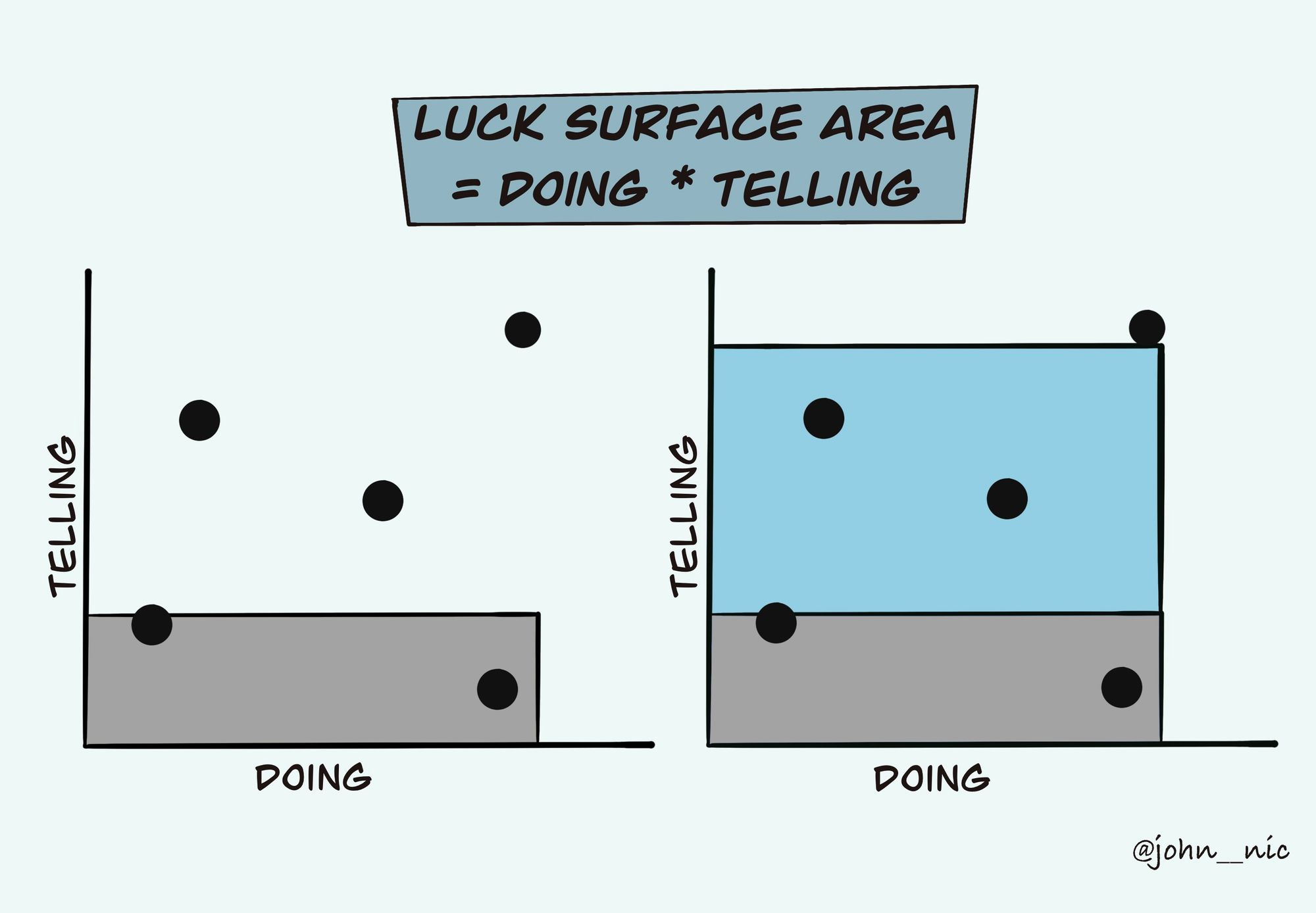
Increasing Your Luck Surface Area
Increasing Your Luck Surface Area

“The amount of luck that you have in life is how much value you create, times how many people you tell about it.” - Patrick McKenzie
Life as an Expat in Germany

The Future of Work
The Future of Work

The way we work is changing. The daily commute is out the window, my suits are gathering dust in the cupboard and Zoom meetings are the order of the day.
My Rules for Life
My Rules for Life

Hey everyone 👋. I'm John. Welcome to Creators' Corner: a place where I share advice on creative experiments & expanding your skillset. Here's the previous edition of the newsletter if you missed it.
My Reading List (Top 30)
My Reading List: 30 Books to Base Your Life On

Hey everyone 👋. I'm John. Welcome to Creators' Corner: a place where I share advice on creative experiments & expanding your skillset. Here's the previous edition of the newsletter if you missed it.
Live and Let Live
Live and Let Live

Hey everyone 👋. I'm John. Welcome to Creators' Corner: a place where I share advice on creative experiments & expanding your skillset. Here's the previous edition of the newsletter if you missed it.
Reviewing the Balance Sheet
Reviewing the Balance Sheet

Hey everyone! We’re into December (can you believe it!) and the year is rushing to a close.
Poor Johnnie’s Almanack
Poor Johnnie’s Almanack

I don’t often read business books. I usually skip the finance section in the newspaper and go straight to sports. I know stock prices should go up and to the right, but for me, life lessons and personal stories are way more interesting than knowing the latest company going bust or reading about who’s IPO-ing next.
Three Ideas to Get the Best Out of the People You Manage
Three Ideas to Get the Best Out of the People You Manage

Hey everyone! I hope you’ve had a great month. Here’s my post for May (I know, I know… sneaking in there just before the closing bell).
20 October 2024
15:13 — on writing as an anchor to your daily life.
The last 3 months have gone by in an instant.
I got married, I got into an MBA program, I’ve been working hard on a client-project, doing sports, trying to be a good friend etc.
But I haven’t been writing. And because of that everything feels like a bit of a blur.
I haven’t recorded as many lessons and observations as previously.
Constantly need to recommit to this habit.
14:49 — beautiful writing/imagery.
“Shrouded in the black thunderheads the distant lightning glowed mutely like welding seen through foundry smoke. As if repairs were under way at some flawed place in the iron dark of the world.” — Cormac McCarthy, The Border Trilogy
14:48 — reconnecting with my internal ambition.
“For a long time, the word “ambition” has been connected with the pursuit of external success, starting from its derivation from the Latin ambitio, which described the act of Roman politicians soliciting votes, or seeking external approval.” — Paul Millerd, Good Work
14:45 — on how behaviour change can lead to spiritual change.
“I resented a practice that can descend into dry and pedantic legalism. But I respected how Judaism has a ritual for every occasion. The idea is that behavior change precedes and causes internal change (a belief well supported by experimental psychology).” — David Brooks, The Second Mountain
14:44 — cool story. Can be applied to other non-negotiables as well.
“Seneca tells a story about Alexander the Great. Apparently as Alexander was conquering the world, certain countries would offer him pieces of their territory in hopes that he’d leave them alone in exchange. Alexander would tell them, writes Seneca, that he hadn’t come all the way to Asia to accept whatever they would give him, but instead they were going to have to accept whatever he chose to leave them. According to Seneca, we should treat philosophy the same way in our lives. Philosophy shouldn’t have to accept what time or energy is left over from other occupations but instead we should graciously make time for those other pursuits only once our study is finished. — Ryan Holiday, The Daily Stoic
14:40 — three months into “not lying” and it’s going well.
Resonate with this.
“Honesty is a gift we can give to others. It is also a source of power and an engine of simplicity. Knowing that we will attempt to tell the truth, whatever the circumstances, leaves us with little to prepare for. Knowing that we told the truth in the past leaves us with nothing to keep track of. We can simply be ourselves in every moment.” — Sam Harris and Annaka Harris, Lying
Life is much simpler. I feel empowered by revealing my true self, my true needs, my true motivations. People respect this too. It’s refreshing.
14:24 — I finally upgraded to full membership of the Making Sense podcast two weeks ago.
I don’t listen to a lot of podcasts. Only Sam Harris. I like his calm, rational, measured approach to thorny, current topics. In a way, he is my moral compass in a world where people have swung too far right and left.
Every talk is excellent. It’s a great to understand the context (and the underlying truth) of the latest events in the world.
Feels like $70 p.a. well spent.
14:22 — recurring theme. Doing the work for the work itself.
“When we do the work for itself alone, our pursuit of a career (or a living or fame or wealth or notoriety) turns into something else, something loftier and nobler, which we may never even have thought about or aspired to at the beginning. It turns into a practice.” — Steven Pressfield, Turning Pro
Inputs over outputs.
“Either way, you are putting yourself on a slippery slope when you start believing that the outcome of your effort represents or embodies who you really are as a person— what your value as a person is. I speak from personal experience.” — Bill Walsh, The Score Takes Care of Itself
17 October 2024
20:09 — on your worst self often being your true self. So make sure your worst self is an upstanding citizen.
“Surely what a man does when he is taken off his guard is the best evidence for what sort of a man he is? Surely what pops out before the man has time to put on a disguise is the truth? If there are rats in the cellar you are most likely to see them if you go in very suddenly. But the suddenness does not create the rats: it only prevents them from hiding. In the same way the suddenness of the provocation does not make me an ill-tempered man; it only shows me what an ill-tempered man I am. The rats are always there in the cellar, but if you go in shouting and noisily they will have taken cover before you switch on the light.” — C.S. Lewis
15 October 2024
21:10 — Good Work in a nutshell.
“Good work: activities that give me energy and fuel my journey “Good enough” work: tasks I enjoy to some degree, which often help pay the bills, but are not my core good work Supporting activities: complementary work that supports my good work, but is sometimes a distraction “Bad” work: work I seek to avoid. Anything that drains my energy, but sometimes necessary to pay the bills.” – Paul Millerd, Good Work
14 October 2024
Had my first session with my old coach today.
We did an exercise where I was supposed to breathe and imagine myself saying no to the MBA program.
I felt calm. It felt good.
I want to write two things:
How I reject this seemingly incredible opportunity. It feels brave to say no. I feel calm. It’s about the money, but not really. It’s about Jess, but not really. Don’t want to do things for prestige. Don’t want to do this because I feel inadequate. I know enough about finance, I’ve done a lot of self-development. I will continue doing it. I say I’m doing it for the network and the foot in the door - sure. I say I can’t get sales without it. But that’s not true. I haven’t really tried. I can probably help other smaller companies. I might do Executive Leadership course one day. Sitting there at house parties, in a foreign city, doesn’t appeal to me. Not impressed by the class so far.
How I accept it. Not sure. Don’t want people to overlook me. I like the warm intros.
What’s holding me back:
don’t want to disappoint people
don’t want to say no to this opportunity - most people would give anything to be part of it.
Want to chat to Carla again.
James.
Harry re Bain. Case studies.
I am frustrated that I can’t make up my mind. Kills me.
Vision:
continue consulting
podcast/ interviews/ videos/ writing - about business lessons, leadership in business
try to get additional revenue streams going - pitch Feather again
fractional product development guy for insuretechs
business coach
work remotely, travel, be at home with Jess and Lily
It’s been a good exercise.
22:31 — some of my daily habits. These work for me, mileage might vary.
No phone before bed. Leave phone in my study. Notepad + pen for notes. Kindle for reading.
Read every single night. At least 10 minutes.
No phone when I wake up.
Go for a walk, exercise first thing if I can.
No breakfast. Just doesn’t work for me. Tried it again this year and gained a lot of weight. Rather just have black coffee and make lunch my first meal.
Writing. Can I make this a habit again. I’ve been dropping myself lately.
No alcohol during the week. No series during the week.
Timeboxing social media time. 1h window over lunch - use it or lose it.
Try to cut sugar as much as possible. Weakness.
Weekends are more chilled, fewer rules.
10:45 — on ambition.
I want to step out of the shadows.
I want to share more of my work again.
I’ve been playing it small for a while.
Nobody wins that way.
Goals for Q4:
Post a video. Take an essay and create a YouTube.
Post more on LinkedIn and Substack. X/Twitter is over. I’ve explained this before, but I put way too much time into it, took over my life and impacted mental well-being.
Build a product - like the daily task tracker or the logging app.
Redesign my website. Nate Kadlac has great resources for this.
Learn how to become a coach.
Sales / bus dev.
12 October 2024
10:43 — Hemingway throwing shade.
“Writers are forged in injustice as a sword is forged. I wondered if it would make a writer of him, give him the necessary shock to cut the over-flow of words and give him a sense of proportion, if they sent Tom Wolfe to Siberia or to the Dry Tortugas.” — Ernest Hemingway, Green Hills of Africa
Be more exact. Cut, edit, remove the fluff.
10:41 — cool description of our fear of failure.
“Anyone whose goal is ‘something higher’ must expect some day to suffer vertigo. What is vertigo? Fear of falling? Then why do we feel it even when the observation tower comes equipped with a sturdy handrail? No, vertigo is something other than the fear of falling. It is the voice of the emptiness below us which tempts and lures us, it is the desire to fall, against which, terrified, we defend ourselves.” — Milan Kundera, The Unbearable Lightness of Being
10:39 — on the realities of making a living. The constant inner battle between the artist and the suit.
“Were they that much more clever than I? The only difference was money, and the desire to accumulate it.” — Charles Bukowski, Factotum
This was me last year. Someone who pursued their craft and didn’t care about money. I believed in myself and still do, but I wasn’t actively pursuing earning money. But something changed. I ran out of runway. I see the value of money now - that it can buy freedom. It was a tough realization, but an important one. Life isn’t that romantic. There is work out there can give you both money and
10 October 2024
21:03 — McCarthy on war as a forcing function.
“This is the nature of war, whose stake is at once the game and the authority and the justification. Seen so, war is the truest form of divination. It is the testing of one’s will and the will of another within that larger will which because it binds them is therefore forced to select. War is the ultimate game because war is at last a forcing of the unity of existence. War is god.” — Cormac McCarthy, Blood Meridian
20:54 — did McCarthy read McKenna or vice versa?
“For me the world has always been more of a puppet show. But when one looks behind the curtain and traces the strings upward he finds they terminate in the hands of yet other puppets, themselves with their own strings which trace upward in turn, and so on. In my own life I saw these strings whose origins were endless enact the deaths of great men in violence and madness. Enact the ruin of a nation.” — Cormac McCarthy, The Border Trilogy
08 October 2024
10:35 — on editing.
Cool observation today. My writing partner, Rik, just published his 100th essay in a row. That means I’ve been editing writing for (at least) 100 weeks.
Does that make me an editor? I guess so.
10:31 — on listing when you felt most fulfilled.
“In his essay “Schopenhauer as Educator,” Nietzsche wrote that the way to discover what you were put on earth for is to go back into your past, list the times you felt most fulfilled, and then see if you can draw a line through them.” — David Brooks, The Second Mountain
Reminds me of this line by Jung.
“What did you do as a child that made the hours pass like minutes? Herein lies the key to your earthly pursuits.” ― Carl Jung
10:30 — on the pros and cons of self-employment
While I’m grateful for self-employment (I have freedom and autonomy), I also realise how limiting it can be from time to time.
Can’t get a loan.
Selling time.
Other people can use you.
10:25 — right here, right now.
“This moment right now, to paraphrase Emerson, is a quotation of the moments that have come before and will come ever after. This idea is expressed nowhere more beautifully than in the Christianity hymn Gloria Patri. “As it was in the beginning, and now, and always, and to the ages of ages.”” — Ryan Holiday, The Daily Stoic
10:22 — on the importance of your environment.
“Never underestimate the power of the environment you work in to gradually transform who you are. When you choose to work at a certain company, you are turning yourself into the sort of person who works in that company. That’s great if the culture of McKinsey or General Mills satisfies your very soul. But if it doesn’t, there will be some little piece of yourself that will go unfed and get hungrier and hungrier.” — David Brooks, The Second Mountain
10:20 — keep moving up the pyramid of needs. Get to self-actualization.
“If you wanted to generalize a bit, you could say there are six layers of desire: Material pleasure. Having nice food, a nice car, a nice house. Ego pleasure. Becoming well-known or rich and successful. Winning victories and recognition. Intellectual pleasure. Learning about things. Understanding the world around us. Generativity. The pleasure we get in giving back to others and serving our communities. Fulfilled love. Receiving and giving love. The rapturous union of souls. Transcendence. The feeling we get when living in accordance with some ideal.” — David Brooks, The Second Mountain
07 October 2024
16:31 — on killing your darlings.
“There was a great deal of material that Hemingway wrote for A Moveable Feast that he decided to leave out, acting “by the old rule that how good a book is should be judged by the man who writes it by the excellence of the material that he eliminates.” — Ernest Hemingway, A Moveable Feast
16:25 — on letting go.
“According to Anthony de Mello, “there is one thing and only one thing that causes unhappiness. The name of that thing is Attachment.” Attachments to an image you have of a person, attachments to wealth and status, attachments to a certain place or time, attachments to a job or to a lifestyle. All of those things are dangerous for one reason: they are outside of our reasoned choice. How long we keep them is not in our control.” — Ryan Holiday, The Daily Stoic
Felt this a bit when I quit my corporate job, became self-employed, struggled to get clients.
16:56 — struggling with this currently. I want to do more deep work.
“If you give your mind something meaningful to do throughout all your waking hours, you’ll end the day more fulfilled, and begin the next one more relaxed, than if you instead allow your mind to bathe for hours in semiconscious and unstructured Web surfing.” — Cal Newport, Deep Work
Find myself and my wife watching series most nights. Suppose this will change once we have kids. But for now, it feels suboptimal. I would prefer to do something ‘meaningful’ or higher value than watching someone else’s work every night. But what does that mean for our relationship?
What can we do together that is high-value? Does this mean I will merely have to work late every night and then we get to spend weekends together? Feels strange.
04 October 2024
10:57 — on filling that hollow place.
“We tell stories because we have a hollow place in our heart. You don’t fill that with success. You fill it by finding yourself in the stories you tell.” –Guillermo Del Toro
10:55 - feel this with Jess. As if we are one.
“Gabriel García Márquez captured it when describing an old couple in Love in the Time of Cholera: In the end they knew each other so well that by the time they had been married for thirty years they were like a single divided being, and they felt uncomfortable at the frequency with which they guessed each other’s thoughts …. It was the time when they loved each other best, without hurry or excess, when both were most conscious of and grateful for their incredible victories over adversity. Life would still present them with other mortal trials, of course, but that no longer mattered: they were on the other shore.” — David Brooks, The Second Mountain
10:51 — on self-awareness.
“As Goethe’s maxim goes, it is a great failing “to see yourself as more than you are.” How could you really be considered self-aware if you refuse to consider your weaknesses?” — Ryan Holiday, The Daily Stoic